The Athletes Ukraine Has Lost, and the Helmet That Wouldn't Come Off
Nearly 600 named Ukrainian sports figures have been killed since Russia's invasion began. At the 2026 Winter Olympics, skeleton racer Vladyslav Heraskevych wore a helmet carrying 24 of their portraits, and was disqualified for it.
By Miles Ashworth · 15 Feb 2026 · 4 min read · United Kingdom edition
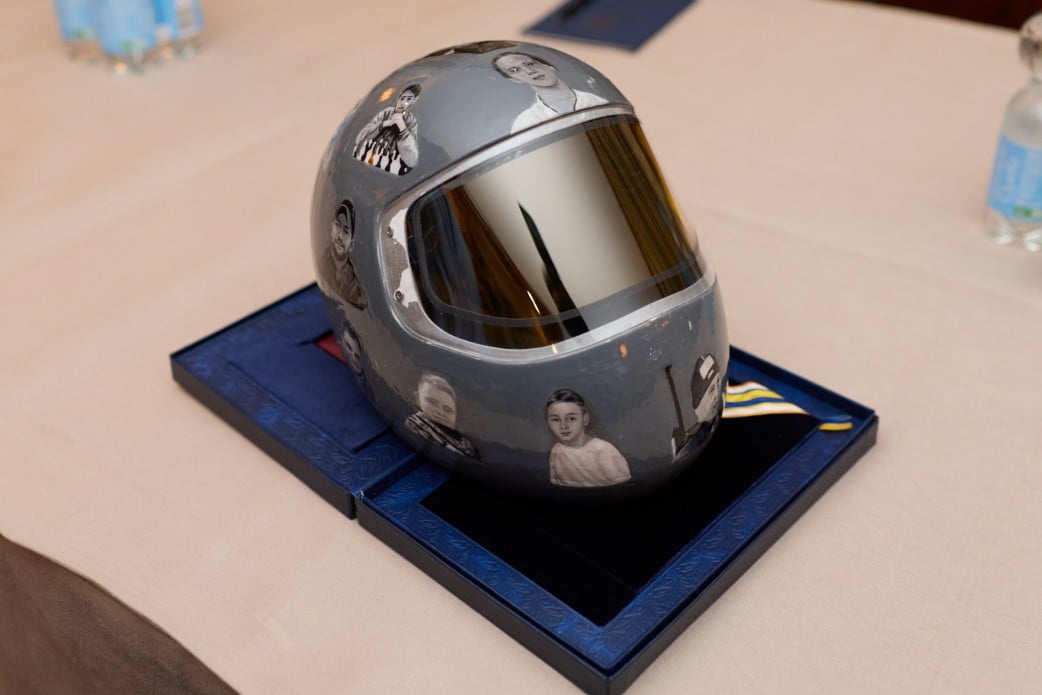 The helmet of remembrance, painted with portraits of Ukrainian athletes killed in the war, presented in its award box, February 14, 2026. Photo: The Presidential Office of Ukraine, via Wikimedia Commons (CC BY 4.0).
Since Russia's full-scale invasion began in February 2022, Ukraine's sporting world has lost people it should never have had to lose. Wikipedia's own running tally of named Ukrainian sports figures killed during the Russo-Ukrainian war, which dates the conflict back to 2014 but counts the overwhelming majority of deaths from the 2022 invasion onward, documents nearly 600 individuals by name. The Embassy of Ukraine in the USA has put the figure higher still, saying Russian attacks and the war more broadly have killed more than 650 Ukrainian athletes and coaches, with thousands more serving in the military or in national defence efforts while continuing, where they can, to train and compete.
The names behind that number cover almost every sport Ukraine plays. Figure skater Dmytro Sharpar was killed on March 31, 2022. Boxers Sviatoslav Aleksapolskyi and Stanislav Artemenko died months apart in the summer of 2022. Sport dancer Daria Kurdel was killed on July 9, 2022. Track athletes Taras Lavriv and Serhii Pronevych, judoka Yana Rykhlitska, cyclist Oleksandr Kulyk, skier Yevhen Holovan, and footballers including Vitalii Sapylo, Mykhailo Boychenko and Serhiy Shestak all appear on the same list, most of them killed within weeks of the invasion's start. Some died on the front line as soldiers. Some died as civilians, in their homes or their cities, under Russian strikes.
The infrastructure Ukrainian sport was built on has been hit just as hard. According to the Embassy of Ukraine in the USA, "Russian attacks destroyed more than 800 sports facilities, including over 20 Olympic, Paralympic, and Deaflympic training centres." That's not an abstract number for the athletes who trained in those buildings, it's the gyms, tracks, pools and rinks a generation of Ukrainian competitors grew up in, gone.
A Helmet Full of Names
At the 2026 Winter Olympics in Milan-Cortina, Ukrainian skeleton racer Vladyslav Heraskevych, the first Ukrainian to ever qualify for the sport at an Olympics, wore what he called a "helmet of memory" through every training run. Designed by Ukrainian artist Iryna Prots, it carried portraits of 24 Ukrainian athletes killed in the war, among them shooter Oleksiy Habarov and hockey player Oleksiy Loginov, both killed as soldiers, and weightlifter Alina Perehudova, dancer Daria Kurdel and figure skater Dmytro Sharpar, all civilians killed in Russian airstrikes.
The International Olympic Committee invoked Rule 50 of the Olympic Charter, which restricts political demonstrations on the field of play, and asked him to stop wearing it. IOC spokesman Mark Adams said the committee wanted competition itself to "concentrate on the athletes' performance and sport on the field," kept separate from "all types of interference." As a compromise, the IOC offered Heraskevych a black armband instead, a way to mark the tribute without the portraits themselves appearing at the venue.
Heraskevych refused it. He argued that a memorial wasn't a political statement, and that he didn't have time before competition to source alternative equipment even if he'd wanted to. Asked to weigh the risk to his own Olympic result, he said a medal was "worthless in comparison to people's lives and...the memory of these athletes." He kept training in the helmet.
On February 12, 2026, the jury of the International Bobsleigh and Skeleton Federation disqualified him from competition over the equipment, marking his result DSQ. He appealed to the Court of Arbitration for Sport. The appeal was dismissed the next day, February 13, 2026.
Ukrainian President Volodymyr Zelenskyy called the decision a "betrayal," and on February 14, 2026, awarded Heraskevych the Order of Liberty, one of Ukraine's highest civilian honours, in person. Among Ukrainian athletes at the Games and beyond, a phrase spread in solidarity with him: "Remembrance is not a violation."
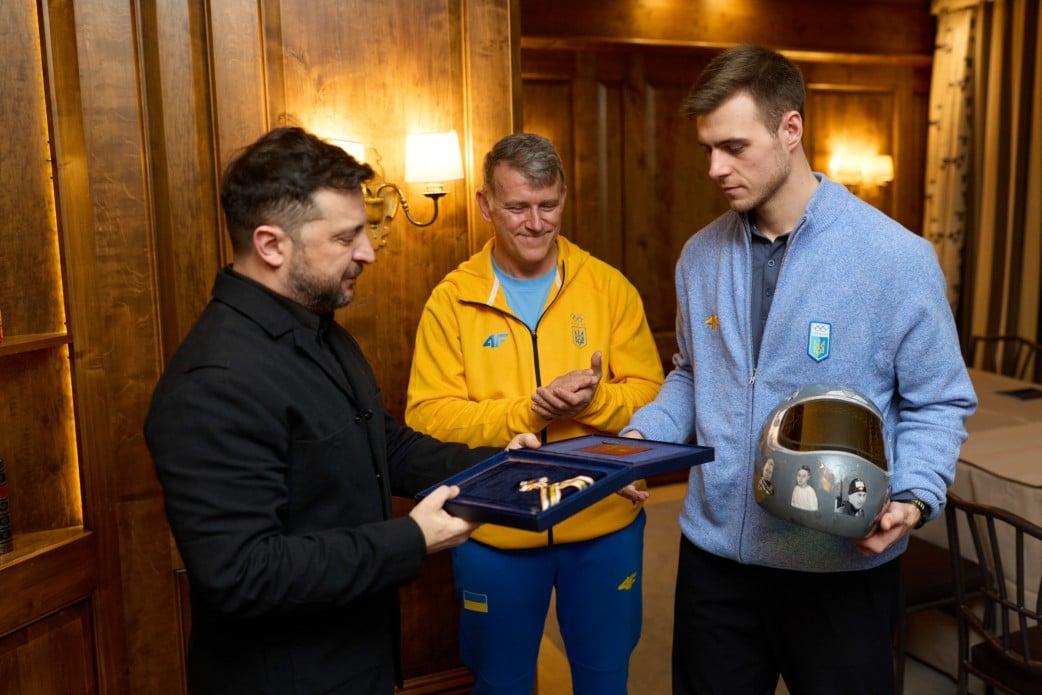 Vladyslav Heraskevych holds the helmet of remembrance as Ukrainian President Volodymyr Zelenskyy presents him with the Order of Liberty, February 14, 2026. Photo: The Presidential Office of Ukraine, via Wikimedia Commons (CC BY 4.0).
A Games Without a Medal
Ukraine sent 46 athletes across 11 sports to Milan-Cortina and left without a single medal, its first medal-less Winter Olympics since 2010. Set against everything else the country's sporting world has lost since 2022, a blank medal table barely registers as the headline. The athletes who did make it to the start line at all, training through blackouts, air raid sirens and the loss of teammates, had already done something the results sheet doesn't measure.