Ancient Sports: The Mesoamerican Ballgame ("Mayan Football")
Nearly 3,000 years of history, real archaeology — and a sacrifice myth that needs careful handling.
By Miles Ashworth · 28 Aug 2026 · 2 min read · United Kingdom edition
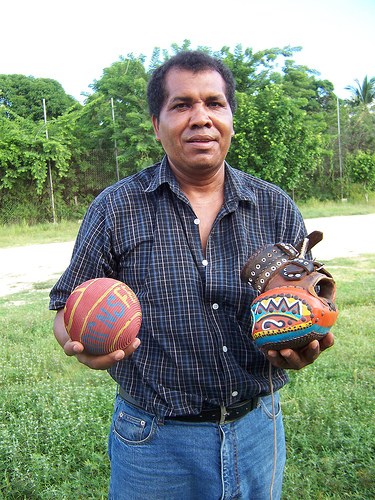 Scott Kraft, via Wikimedia Commons (CC BY-SA 2.0)
The Mesoamerican ballgame was played for nearly 3,000 years before a single European ever set foot in the Americas. The Maya, Aztecs, Olmecs and other cultures across the region played versions of it from at least 1650 BCE — rubber balls have been found at the Olmec site of El Manatí dating that far back — through to the Spanish conquest. Archaeologists have identified more than 1,300 ballcourts across Mesoamerica, all built to a consistent 4:1 length-to-width ratio despite enormous variation in size: Chichén Itzá's Great Ballcourt is 96.5 metres long, while Tikal's is barely a sixth of that.
Played with a solid rubber ball and struck primarily with the hips rather than hands or feet, the game mattered enough to shape the wider economy: the Codex Mendoza records 16,000 lumps of raw rubber shipped to Tenochtitlán every six months, largely to keep courts across the empire supplied. Emperor Axayacatl is recorded as once wagering his entire annual income on a single match. After the conquest, Hernán Cortés was sufficiently impressed to send a team of Aztec ballplayers to perform for Charles V in Spain in 1528.
The game's popular reputation — that losing players, or at least their captain, were routinely beheaded — comes from the Popol Vuh, the Kʼicheʼ Maya creation narrative, not from archaeological consensus. Imagery connecting the ballgame to sacrifice does exist in the record, but appears relatively late, and the mainstream summary of the scholarship is careful to say losing players "are assumed," not confirmed, to have been sacrificed. The honest version is more interesting than the myth: a genuinely high-stakes, economically and politically significant sport that carried real ritual weight, not a straightforward death match.
The game never fully disappeared. Ulama, a netless, hip-strike descendant of the ancient ballgame, is still played today by indigenous communities in Sinaloa, Mexico — and pelota mixteca, a related regional variant, survives in Oaxaca. Nearly three and a half millennia after the first rubber ball at El Manatí, a recognisable version of the same game is still being played by hand, hip and shoulder, not preserved behind museum glass.