From Stumbling to Sub-51 Minutes: Inside China's Robot Sports Boom
In twelve months, China's humanoid robots went from struggling to finish a half marathon to beating the human world record. This is the fastest-moving frontier in sport right now, and it's real, dated, and already drawing serious money.
By Miles Ashworth · 26 Aug 2026 · 3 min read · United States edition
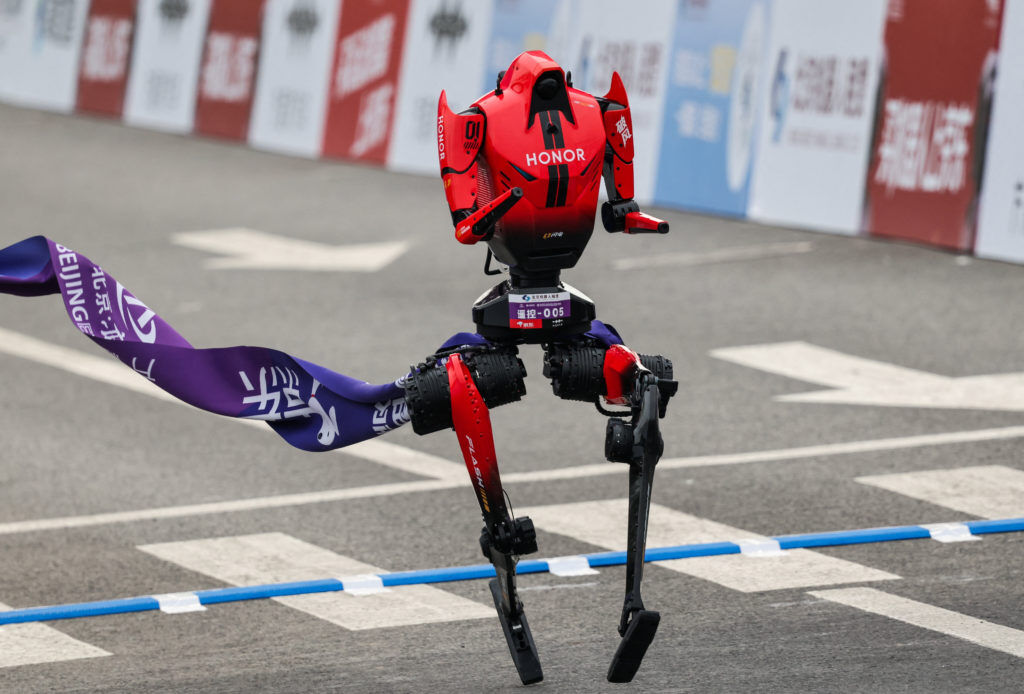 Maxim Shemetov/Reuters, via PBS
On 19 April 2025, roughly twenty humanoid robots from about twenty teams -- including Unitree and X-Humanoid -- lined up alongside 1,200 human runners for the Beijing E-Town Half Marathon, in what organisers billed as the world's first humanoid robot half marathon. It did not go smoothly. The winning robot, Tiangong Ultra, finished in 2 hours 40 minutes 27 seconds -- more than ninety minutes behind the human winner's 1:11:07 -- and only one robot finished inside the 3-hour-10-minute cutoff at all.
One year later, on 19 April 2026, more than 300 robots entered the same event. The winner, a robot called "Lightning" built by smartphone maker Honor, finished in 50 minutes 26 seconds -- beating the human half-marathon world record by roughly seven minutes, running alongside a human field that had grown to over 12,000. Twelve months, in other words, took the field from barely finishing to beating humanity's best.
The half marathon wasn't an isolated stunt. Beijing hosted the first-ever World Humanoid Robot Games from 14-17 August 2025: 280 teams, more than 500 robots, 26 events spanning boxing, football, athletics, and even cleaning and medicine-sorting tasks. The standout moment was the world's first fully autonomous 5-a-side robot football match -- no human intervention, no remote control -- in which Tsinghua University's team, "Hephaestus," beat Germany's HTWK Robotics/Nao Devils 1-0 in the final. It wasn't polished: robots collapsed mid-play during the football, and collided with each other during a 400m relay. That roughness is arguably the most useful detail for a sports audience -- this is genuinely early-stage competition, not a choreographed demo. A second Games followed in August 2026.
Combat sports got their own robot version, twice over, in 2025. On 25 May, state broadcaster China Media Group staged the "Mech Combat Arena Competition" in Hangzhou -- the world's first humanoid robot combat event, built around choreographed, motion-captured martial-arts moves, in partnership with Unitree. In December, Shenzhen hosted URKL, launched by a company called EngineAI and billed as the first freestyle -- unchoreographed -- humanoid combat tournament, with 32 teams from around the world all competing on EngineAI's standardised "T800" robot platform.
None of this is happening in a vacuum. China's government made humanoid robotics an explicit strategic priority in a 2023 industry directive, and a 2026 mandate reportedly requires 10,000 humanoid robots to be actively working in factories, warehouses, hospitals and disaster response by the end of the year. Chinese manufacturers are widely reported to account for the large majority of global humanoid robot shipments, though the exact percentage varies enough by source that it's worth stating in general terms rather than picking one specific figure. The clearest sign of real money moving in: Unitree's Shanghai IPO in August 2026 saw shares jump more than 600% on debut, raising roughly ¥6.1 billion (about $905 million) after being oversubscribed more than 8,000 times over.
For a sports readership specifically, the interesting thing isn't the robotics -- it's that these are being staged, promoted and covered as actual sporting competitions, with real winners, real records, and now, via Unitree, real stock-market money behind them. Whether that becomes a genuine spectator sport or stays a Chinese-led showcase is the obvious open question -- but the underlying trajectory, stumbling to record-breaking in a single year, is verified, dated, and remarkable on its own.