Britain Sent Its Biggest Ever Team to the World Nomad Games and Came Home With Nothing
Kyrgyzstan closed the sixth Games on Sunday by beating Kazakhstan 12-0 at kok-boru. Forty-three sports, 3,000 athletes, 30 nations on the medal table, and Team GB was not one of them.
By Miles Ashworth · 7 Sept 2026 · 6 min read · United Kingdom edition
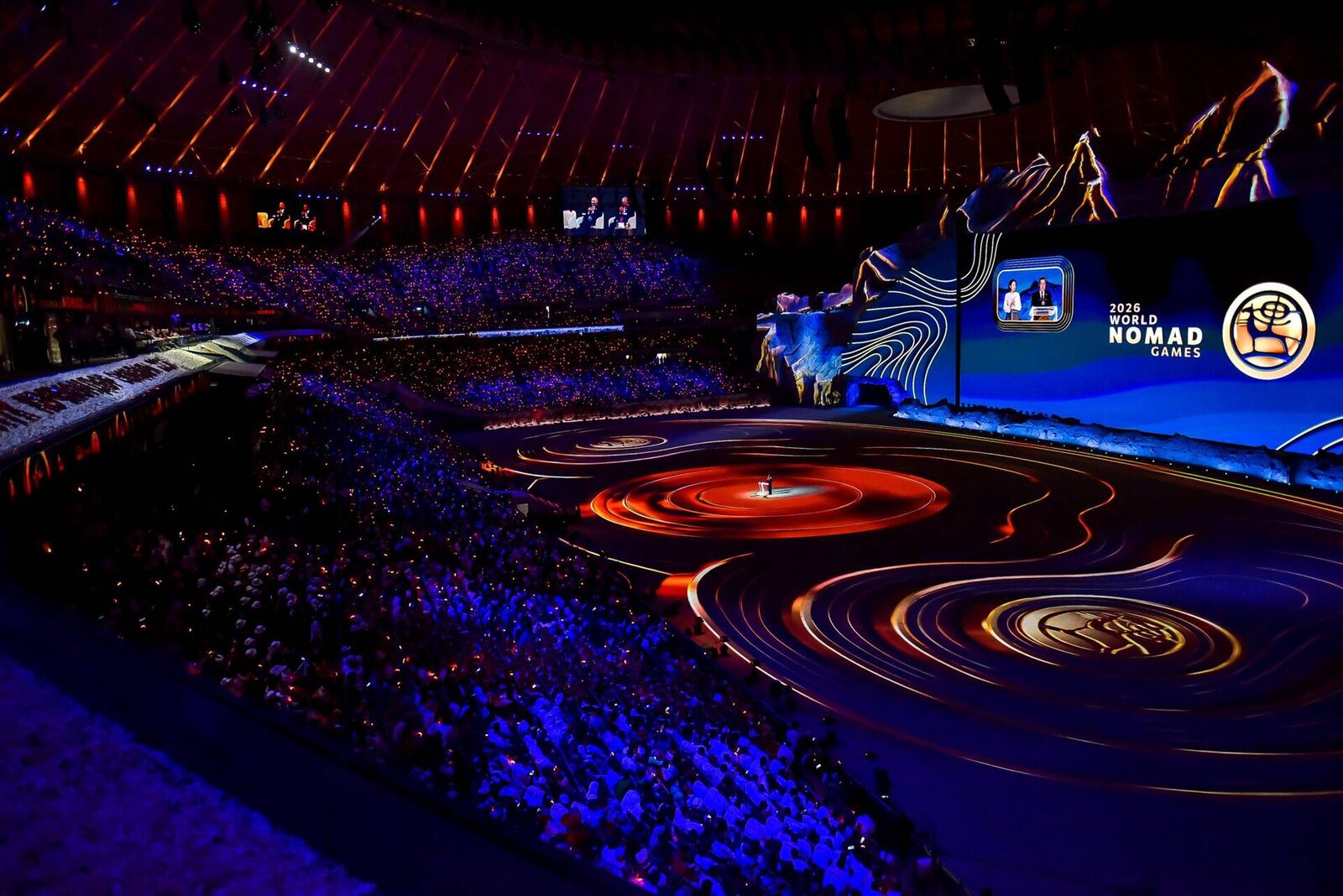 The opening ceremony of the sixth World Nomad Games, Bishkek Arena, 31 August 2026. Photo: Press Service of the President of the Republic of Azerbaijan, via Wikimedia Commons (CC BY 4.0).
On the last night of August, 30,000 people filled a stadium on the western edge of Bishkek that nobody had officially opened yet. Sections of the Bishkek Arena, a 51,000 seater that local media reported is not due to be formally unveiled until October, were still unfinished. It did not appear to bother anyone. The World Nomad Games had come home to Kyrgyzstan, and because 31 August is also Kyrgyz Independence Day, the opening ceremony doubled as a national birthday.
Trick riders worked the floor in the dark. Dancers moved through Kyrgyz history and mythology on an arena laid out to look like an enormous carpet. More than 100 national teams paraded, from the United States to Iran to Ukraine to Belarus. Among them, wearing a flag most of the crowd would not have expected, were more than 50 British athletes.
A Festival Invented in 2014
The World Nomad Games are barely a decade old. They were started in 2014 by the Kyrgyz philanthropist Askhat Akibaev, with a deliberately broad idea behind them: not a showcase of Kyrgyz tradition alone, but a meeting point for nomadic cultures generally. The first three editions were held at Cholpon-Ata, on the northern shore of Lake Issyk-Kul, in 2014, 2016 and 2018. Iznik in Turkey took the 2022 Games, Astana in Kazakhstan hosted in 2024, and this year the event returned to Kyrgyzstan for a fourth time, with the ceremonies in Bishkek and the competition back at Cholpon-Ata.
This edition was the biggest yet by a distance: 43 sports, roughly 3,000 athletes, and an official roster of 104 countries, although Radio Free Europe noticed that Cambodia had been counted twice. Astana in 2024 drew around 1,500 fewer competitors across fewer disciplines. Two years is a short time to almost double an event.
The Sports Themselves
The one that travels is kok-boru, and it travels because it is genuinely startling to watch. Two mounted teams contest a goat carcass, wrestling it from one another at a gallop and attempting to drop it into the opposing team's tai kazan, a raised circular goal that looks a little like a well. Kazakhstan plays a version called kokpar. Afghanistan and neighbouring countries have buzkashi. It is the oldest recognisable ball sport in the region, except that the ball is not a ball.
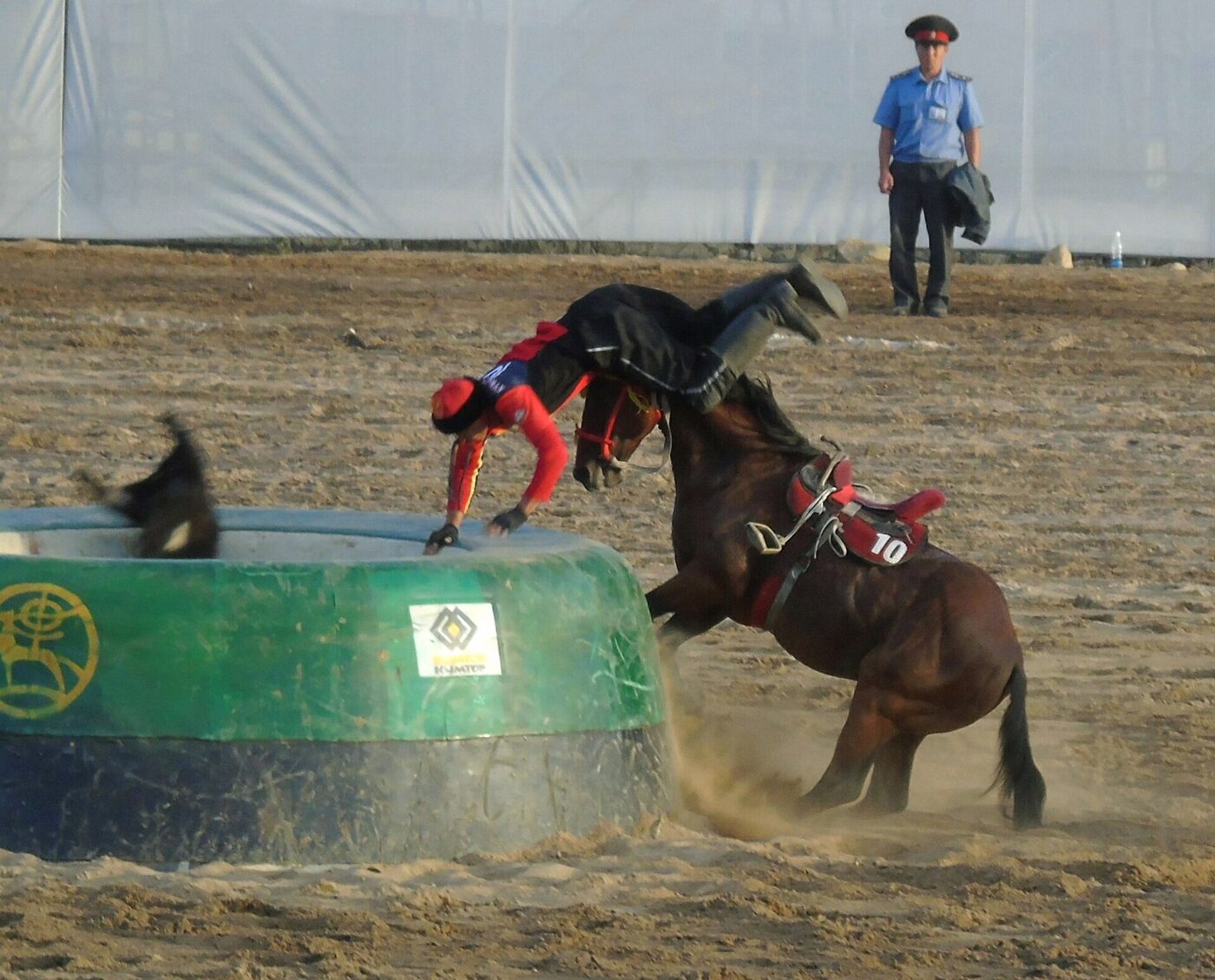 Kok-boru at the 2018 World Nomad Games in Cholpon-Ata, the same venue that staged this year's competition. Photo: Helen Owl, via Wikimedia Commons (CC BY-SA 4.0).
Beyond it, the programme is stranger and more varied than the highlight reels suggest.
Er enish is wrestling on horseback, two riders each trying to drag the other out of the saddle while both animals are moving. Alysh is belt wrestling, contested by grip. Salbuurun is not one sport but a hunting complex broken into three events: burkut saluu, hunting with golden eagles, in which the bird has to find and take a target across open ground; dalba, falconry, scored on how quickly a bird crosses a long field back to its handler; and taigan zharysh, racing the taigan, the Kyrgyz sighthound. Worth noting for anyone about to picture the worst: at the Games the eagles are flown at a stuffed lure, not live quarry.
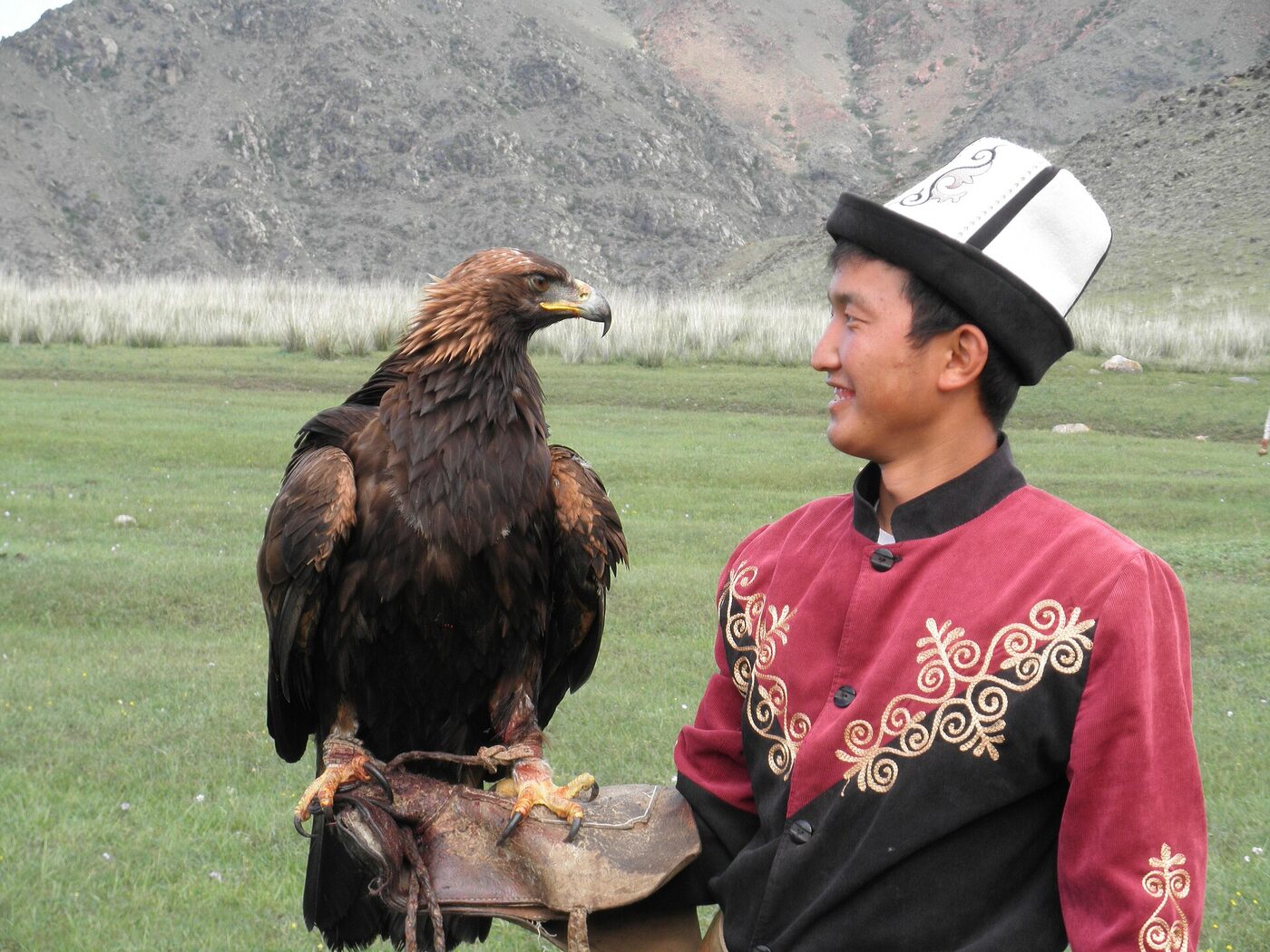 A Kyrgyz hunter with his golden eagle, photographed in 2018. Eagle hunting is contested at the Games as burkut saluu, one of the three salbuurun disciplines. Photo: Stoni111121, via Wikimedia Commons (CC BY-SA 4.0).
Then there is toguz korgool, which is not athletic at all. It is a board game in the mancala family, played on two rows of nine pits with a kazan at each end, nine stones to a pit and 162 stones in total. It sits on the same programme as the horseback wrestling, which tells you something about how the Games define sport.
How It Finished
Kazakhstan won the medal table, and it was closer than the gold count suggests. The Kazakhs took 32 golds from 74 medals. Kyrgyzstan finished second on golds with 30, but won more medals than anyone, 84 in total, including 35 silvers. Russia was a distant third on seven golds and 36 medals, then Mongolia on five, and Uzbekistan on four.
After that it thins out fast. Iran and Turkmenistan took two golds each, Tajikistan two, and then the single-gold nations: Moldova, Ghana, Pakistan, France and South Korea. Of the hundred-plus countries that turned up, only 30 won a medal of any colour.
The hosts got the ending they wanted. In Sunday's kok-boru final at the Kok-Boru Arena in Cholpon-Ata, Kyrgyzstan beat Kazakhstan 12-0. Not a narrow win over the great rival in the sport that defines the Games, but a shut-out, in front of a home crowd, on the last day.
Where the English-Speaking Teams Finished
Britain sent the largest delegation it has ever sent. "The largest-ever British delegation, consisting of more than 50 athletes, will attend the 6th World Nomad Games in Kyrgyzstan," the British Ambassador to Kyrgyzstan, Vicente Solera Deuchar, said before the Games. They entered tug-of-war, horseback archery and wrestling.
They did not win a medal. Not one, of any colour, across the whole week. Great Britain does not appear anywhere on the final table.
That is less damning than it sounds, and the story of how the team exists at all explains why. Team GB at the Nomad Games is not a funded national programme. Sam Pollard, who carried the British flag at the 2024 Games in Astana, told the Times of Central Asia that he and his friends found the event on YouTube and applied on the strength of having done tug-of-war together at university. "Because my friends and I had a tug-of-war background at university, we thought we'd apply, see what happened, and hope for the best." A group of enthusiasts going to Central Asia to wrestle and shoot from horseback against countries where these are national sports was never likely to come home with gold.
The other English-speaking nations did marginally better and are not exactly troubling the top of the table either. The United States finished joint 20th with a single silver. Canada took two bronzes, good for joint 22nd. Australia did not win a medal, and no Australian delegation appears in the coverage of these Games at all.
What Happens Next
The seventh edition is already settled. President Sadyr Japarov announced at the opening ceremony that the 2028 Games will go to Kazan, in the Russian republic of Tatarstan.
That is worth sitting with. The event was founded to be bigger than one country's traditions, and it has genuinely grown, from a regional gathering to something a hundred nations send teams to. It has also become a fixture of a particular diplomatic neighbourhood. This year's opening ceremony was scheduled alongside a Shanghai Cooperation Organisation summit, with Vladimir Putin, Narendra Modi, Ilham Aliyev and Nikol Pashinyan in the stands, and Xi Jinping in the city but not at the Games. In 2028 it moves to Russia.
It would be naive to call an event of that shape purely a sports festival, and unfair to call it purely statecraft. It is both at once. A country of seven million built the largest stadium in Central Asia, filled it on its own independence day, beat its biggest rival 12-0 at its own national sport, and did it in front of 20 heads of state. Whatever else that is, it worked.