Tour de France 2026
Tadej Pogačar won his fifth Tour de France at the fastest average speed in race history. Every stage, all four jerseys, Vingegaard's collarbone-ending crash, and the pre-dawn drug test that overshadowed the day he abandoned.
By Miles Ashworth · 27 Jul 2026 · 7 min read · United Kingdom edition
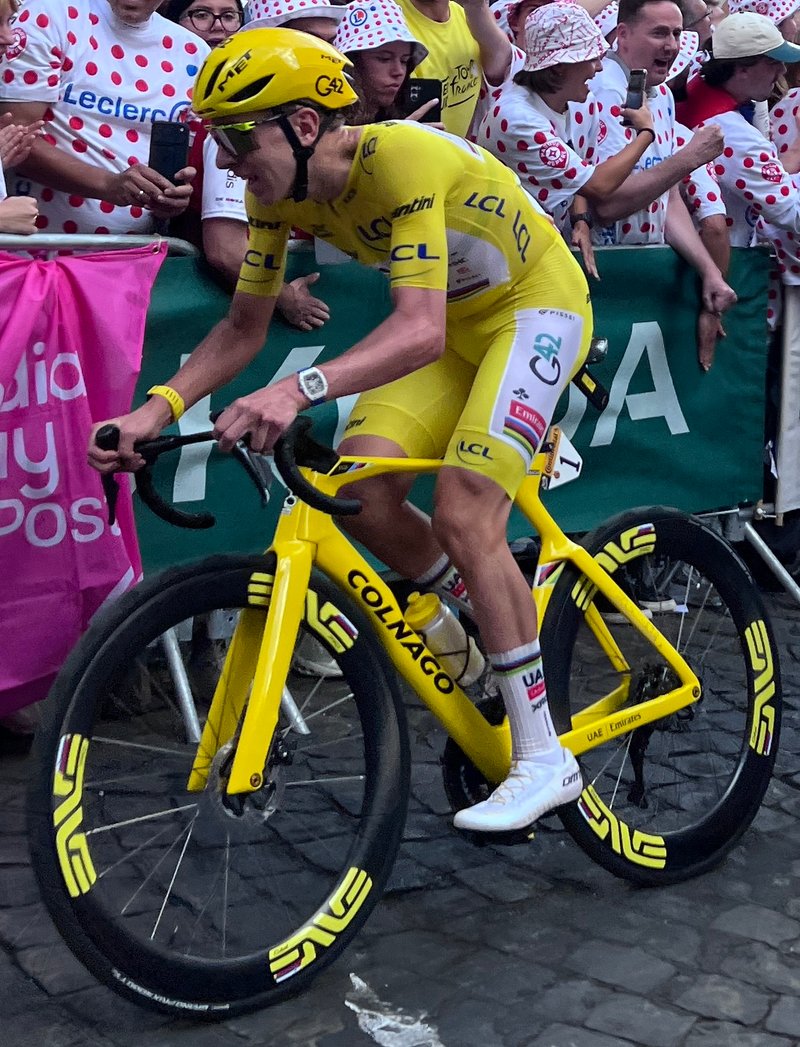
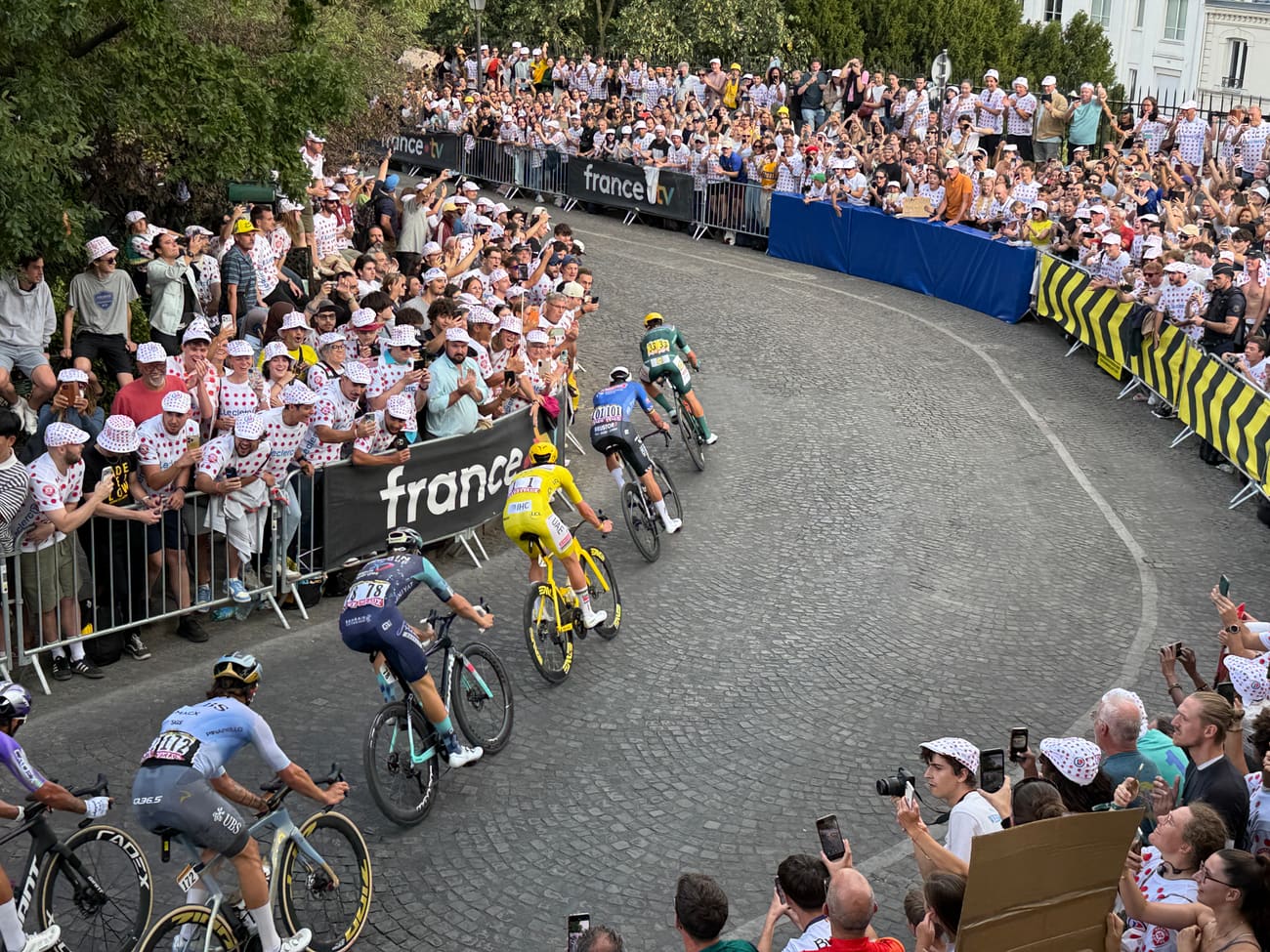 Tadej Pogačar in the yellow leader's jersey on Rue Saint-Éleuthère, Montmartre, during the final stage (Stage 21) of the 2026 Tour de France in Paris, July 26, 2026. Photo: Chabe01, via Wikimedia Commons (CC BY-SA 4.0).
Tadej Pogačar won his fifth Tour de France, run July 4 to 26, 2026, finishing 6 minutes 26 seconds ahead of Remco Evenepoel and doing it at the fastest average speed in the race's history, 43.227 kilometres per hour across the full three weeks. The win ties him with Jacques Anquetil, Eddy Merckx, Bernard Hinault and Miguel Induráin on five Tour titles. Of the 184 riders who started in Barcelona, 158 finished, an 86% completion rate, with Belgium's Cees Bol last on the road as the race's lanterne rouge, 6 minutes 20 seconds behind Pogačar's winning time.
Week One: Barcelona to the Pyrenees
The race opened in Barcelona with a team time trial, the Tour's first since 1971, over 19.6 kilometres, won by Visma-Lease a Bike, putting Jonas Vingegaard in yellow from day one. Isaac del Toro won stage 2's hilly finish around three laps of Montjuïc, before Pogačar took over the race lead himself on stage 3 into Les Angles, a mountain stage run under wildfire warnings that discouraged spectators from attending in the Pyrénées-Orientales region.
Stage 4 to Foix was run in temperatures around 40°C, won by Mads Pedersen, who would go on to build his entire Tour around consistency rather than repeat wins. Olav Kooij won a flat stage 5 into Pau, before the race's first genuinely decisive mountain stage, stage 6 over the Col du Tourmalet into Gavarnie-Gèdre, where Pogačar attacked to open a margin of 2 minutes 38 seconds, effectively setting the shape of the race with more than two weeks still to race. It was also the stage that ended Torstein Træen's Tour: the Uno-X Mobility rider crashed on the descent from the Tourmalet with concussion and multiple rib fractures, and did not start the next day.
Tim Merlier won back to back sprint stages, 7 into Bordeaux and 8 into Bergerac, before stage 9 into Ussel was shortened by 30.9 kilometres due to a red heatwave warning covering the Corrèze department, neither the start nor finish location changed, just the distance between them. Mathieu van der Poel won the shortened stage.
Week Two: The Massif Central to the Vosges
After the first rest day, Pogačar won again on Bastille Day, stage 10 over the Col du Pertus into Le Lioran. Stage 11 into Nevers produced the fastest sprint finish in Tour history, Søren Wærenskjold winning at an average speed of 50.9 kilometres per hour, before Tim Merlier took his third stage win of the race on stage 12 into Chalon-sur-Saône, a stage marked by a large crash further back in the bunch.
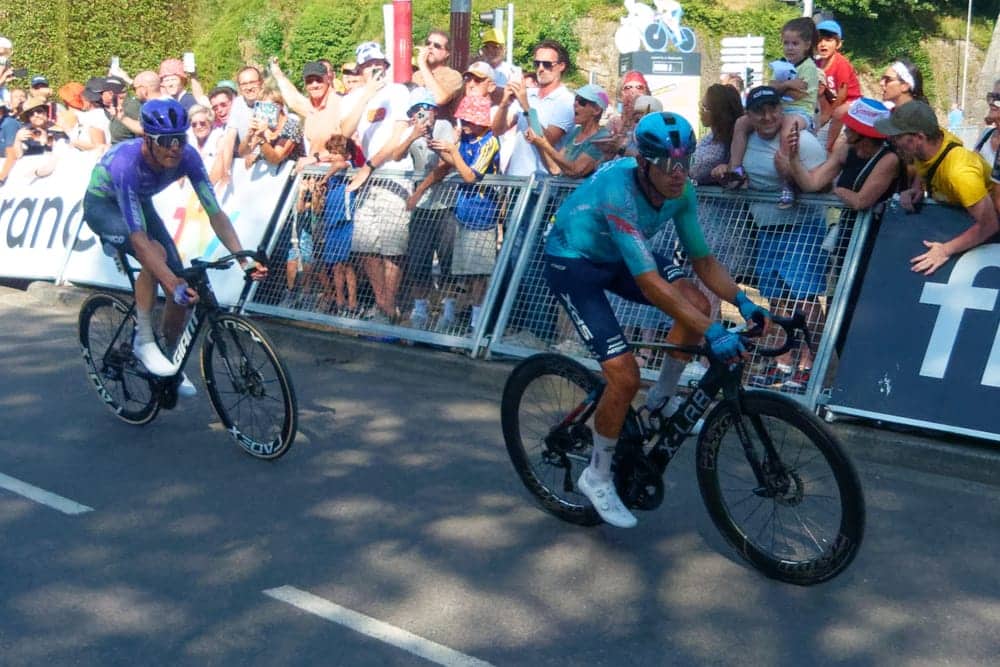 Two riders in a breakaway near Belfort during Stage 13 of the 2026 Tour de France, the stage Mauro Schmid won from the day's break. Photo: Thomas Bresson, via Wikimedia Commons (CC BY 4.0).
Stage 13's 205.8 kilometres into Belfort went to Mauro Schmid from the day's breakaway, before Pogačar won again in the Vosges on stage 14 into Le Markstein by around 40 seconds.
Week Three: The Alps, a Broken Collarbone and a Pre-Dawn Drug Test
Stage 15 into Plateau de Solaison, the race's first-ever summit finish there, was won by Remco Evenepoel, his first Tour mountain stage win. It was also the stage that ended Jonas Vingegaard's title challenge: with around 24 kilometres left to race, the Visma-Lease a Bike leader hit a kerb exiting a roundabout, crashed, and broke his collarbone, abandoning the race that he'd entered as a genuine co-favourite after winning the 2026 Giro d'Italia. Tim Merlier also abandoned during the stage, unrelated to Vingegaard's crash.
The stage was overshadowed before it even started. The International Testing Agency woke Vingegaard at around 2am and Pogačar at around 5am that morning to administer drug tests outside normal testing hours, authorised by a Paris prosecutor. Vingegaard said afterwards, "It's good that they test, but when it's affecting performance and your sleep, I don't think it's so good." Evenepoel called the pre-dawn timing something athletes "should not accept," and "disrespectful." Pogačar said the test had cost him deep sleep too, but that he accepted it "if this is necessary to still prove that we are riding clean." In the aftermath, Pogačar suggested Vingegaard's crash later that day might have been connected to the disrupted sleep, though nothing about the crash itself, a kerb strike exiting a roundabout, points to a confirmed cause beyond the crash itself.
After the second rest day, stage 16's 26.1 kilometre individual time trial into Thonon-les-Bains went to Evenepoel, his second stage win in two days of racing and the Tour's only real individual time trial of the year at just 26 kilometres total. The stage also cost Red Bull-Bora-Hansgrohe's Florian Lipowitz his race: he crashed on the descent, broke his collarbone, and abandoned.
Jasper Philipsen won the race's last flat stage, 17 into Voiron, before the high mountains arrived in earnest. Richard Carapaz won stage 18 into Orcières-Merlette from a breakaway, a stage that also saw Brandon McNulty abandon due to illness. Then came the two stages built around Alpe d'Huez: stage 19, a short, brutal 127.9 kilometres from Gap that finished with Pogačar setting a new record time up the climb itself, beating the mark Marco Pantani had held since 1995, and stage 20's queen stage, three HC-category climbs finishing at Alpe d'Huez again, won by Carapaz, and marked by Sepp Kuss crashing twice inside the final 8 kilometres.
The Finish in Paris, Rerouted by Wildfire
Stage 21 was meant to run 88.7 kilometres into Paris and the Champs-Élysées. Instead it was cut to 43.8 kilometres after security staff were redeployed to tackle wildfires burning in the Gironde region, with the stage start moved to Paris itself and riders bussed in from Thoiry. Organisers added two extra laps of the Champs-Élysées and kept the three finishing circuits that included the Montmartre climb, and Mathieu van der Poel won the stage, his second of the race.
The Jerseys
Pogačar's overall win was decisive rather than close: 6 minutes 26 seconds ahead of Evenepoel in second, with Isaac del Toro third at 9 minutes 42 seconds, winning the white jersey as best young rider on his Tour debut. Paul Seixas finished fourth and Lenny Martinez fifth, both French riders, though neither could turn that into a stage win, part of a French drought that saw no home rider win a stage for only the third time in Tour history and the first time since 1999.
Mads Pedersen won the green points jersey with 559 points from just a single stage win, built instead on consistent placings at intermediate sprints and stage finishes across all three weeks. Richard Carapaz won the polka dot mountains jersey off the back of his two late stage wins at Orcières-Merlette and Alpe d'Huez, and also picked up the race's overall combativity award. Lidl-Trek won the team classification.
A Season Without Some Old Staples, and a Team That Changed Its Name
Commentators noted what the 2026 route left out as much as what it included: no cobblestone sections, no dedicated crosswind stages, no gravel, and barely any time trialling at all beyond the opening team test and the single 26 kilometre individual effort at stage 16.
Off the road, Israel-Premier Tech rebranded as NSN Cycling Team for the 2026 season and raced under a Swiss licence, after Barcelona City Council indicated it wanted to host the Grand Départ without the team following Gaza war protests during the team's participation in the 2025 Vuelta a España.
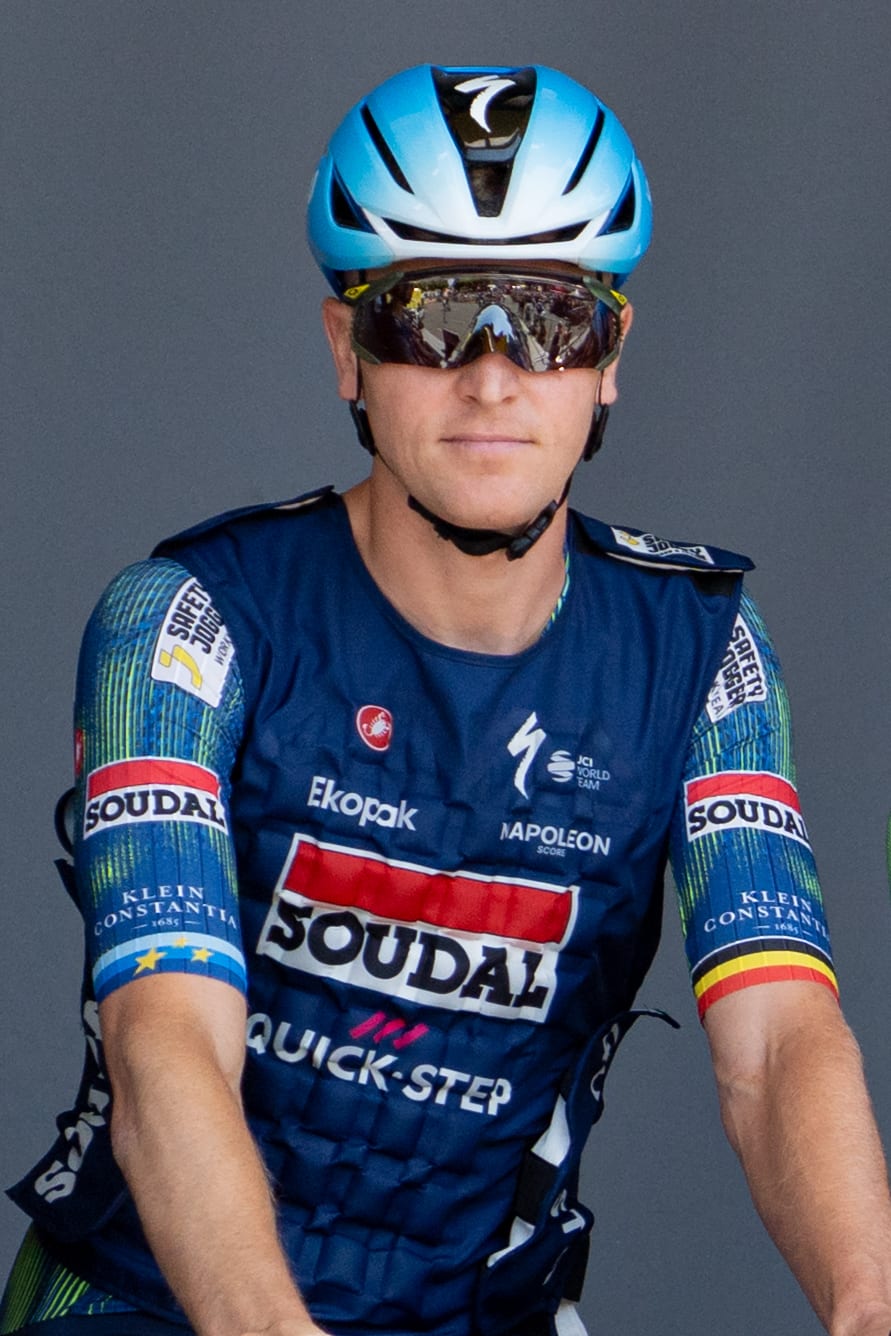 Tim Merlier at the presentation ceremony for Stage 5 of the 2026 Tour de France, per the photo's official Wikimedia Commons title. This is a presentation-ceremony portrait, not a finish-line trophy photo, no podium structure, trophy or flowers are visible in frame. Photo: Hugo LUC, via Wikimedia Commons (CC BY-SA 4.0).
The 2027 route and Grand Départ location hadn't been announced at the time of writing. Race organisers typically confirm the following year's route around October, so more concrete details should emerge well before the 2027 season begins.