Formula E on Steroids: Why F1's Drivers Are Fighting the 2026 Rules
Verstappen calls the 2026 cars anti-racing. Piastri calls it a bad way to go racing. The FIA says the alternative would be worse.
By Miles Ashworth · 27 Aug 2026 · 4 min read · United Kingdom edition
 Angy464, via Wikimedia Commons (CC BY-SA 4.0)
In February 2026, during pre-season testing, Max Verstappen described Formula 1's new 2026 cars as "Formula E on steroids" — his verdict on regulations built around a near 50:50 split between combustion and electrical power. He called the racing "anti-racing," said the cars couldn't be driven flat out, and warned that he needs to get real satisfaction from driving to stay in the category at all. Five months later, at Spa, Oscar Piastri was blunter still, describing the situation as "a pretty crap way of going racing" and saying grids were increasingly being decided by "computers behaving or misbehaving."
What both drivers are objecting to is the power unit's deployment software — described in F1's own technical materials as "forward-thinking algorithms and self-learning systems" that predict the optimal way to release energy lap by lap. Piastri says the algorithm "learns from previous laps, constantly adapting to the input it gets from the driver," to the point that something as small as how a driver handles an out-lap can shape what the engine allows on the next one. It's a genuinely new kind of complaint for the sport: not that the cars are too fast or too slow, but that a piece of software is quietly making decisions the driver used to make.
The FIA's answer is that manual control would make things worse, not better. Nikolas Tombazis, the FIA's single-seater director, has argued that giving drivers full discretion over energy deployment "would use all energy on corner exit for a very limited amount of time" — more of the straight-line power drop-off ("clipping") drivers already dislike, not less. His broader point is blunter: "I don't think humans can rationally control all of these parameters." The regulations exist, in other words, because the alternative isn't a simpler car — it's an unmanageable one.
That doesn't mean the FIA sees no problem. Tombazis has called the situation "complicated" and "more complicated than we would like," and pointed to an already-announced rebalancing of the power split for 2028 as the real fix, not a mid-2026 rewrite. Asked whether driver criticism had gone further than expected, he was characteristically dry: "I think drivers are, by definition, quite demanding clients. I don't think we expected them to have a sugar coat or to not speak their minds."
 Yu Chu Chin (Pangalau), via Wikimedia Commons (CC BY-SA 4.0)
The pattern repeats elsewhere in the rulebook, just in the opposite direction. F1's cost cap — introduced in August 2020 at $145 million a season specifically to stop the biggest teams simply outspending everyone else — has been raised to $215 million for 2026, a 48% increase, and even that figure excludes major categories like driver salaries and marketing. Where the power unit rules tightened control and drivers pushed back, the cost cap loosened under the same kind of pressure from the teams it was meant to restrain.
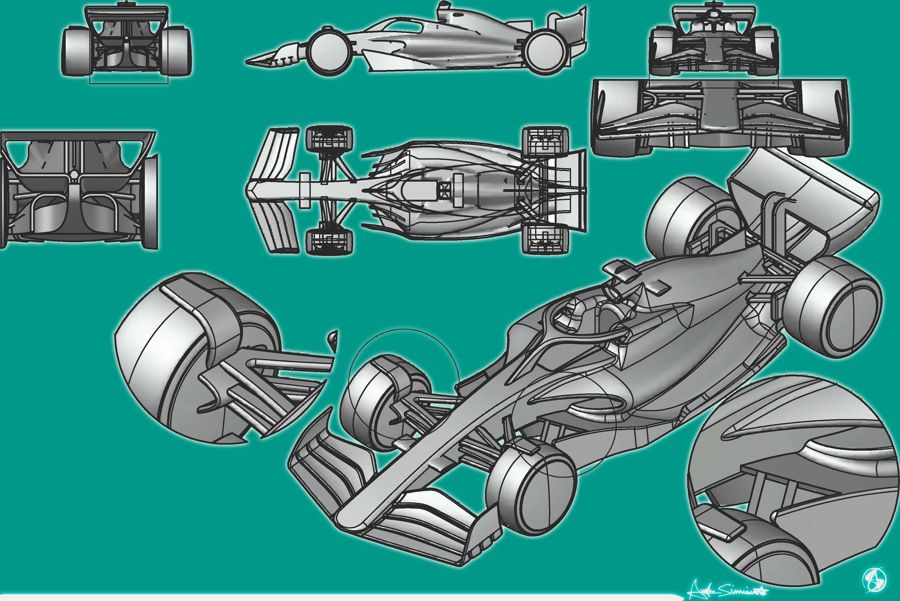
Aerodynamics tell a similar story of the regulator compromising rather than holding a hard line. The 2026 chassis rules were originally set to cut downforce by roughly 40% from the previous generation; the final version lands closer to 15%. It's the same shape as the cost cap change — a headline number softened once the people who have to race, or spend, under it pushed hard enough.
None of this was resolved by argument alone. After a month of meetings between technical heads, drivers, team principals and the FIA, F1 announced a set of live in-season tweaks: the qualifying recharge limit cut from 8MJ to 7MJ, "superclip" power raised to 350kW, race-boost capped at +150kW rather than left unlimited, and a new low-power start-detection system after complaints about how the cars behaved off the line. F1 was careful to frame this as calibration, not retreat — in one line from the sport's own response to the criticism: "We don't want to put tape on anyone's mouth."
What's left, several races into a live experiment, is a genuine disagreement rather than a settled verdict. Verstappen's "anti-racing" and Piastri's "crap way of going racing" haven't been withdrawn; nor has the FIA backed off its core argument that the algorithms exist because the alternative is worse, not because anyone particularly wanted them. Red Bull's widely-reported 2021 cost-cap breach is sometimes raised in the same conversation about whether F1's spending rules ever really held — worth noting as reported, not as independently confirmed here. On the actual question — too tight, or not tight enough — 2026's answer so far is: depends which rule you're looking at, and the sport is still finding out in real time.