UEFA Pursues a Criminal Case Against FIFA's Infantino, Drops Its Boycott Threat
UEFA threatened to pull Europe's teams out of FIFA competitions over Infantino's plan to sell a stake in the World Cup. The plan is dead, the boycott is suspended, and UEFA is now building a criminal case.
By Miles Ashworth · 27 Aug 2026 · 3 min read · Australia edition
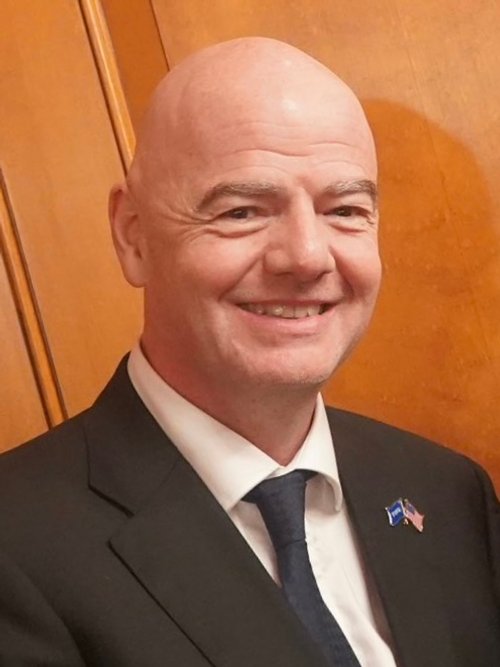 FIFA president Gianni Infantino, 2024. Public domain, via Wikimedia Commons.
UEFA is preparing a criminal complaint in Switzerland against FIFA president Gianni Infantino over his failed plan to sell a stake in the World Cup's commercial rights. On Thursday 27 August it filed papers in two American courts asking for access to documents it wants to use in that Swiss case.
On the same day, UEFA's member federations suspended the threat that had hung over the dispute for a month: that no European national team would take part in any FIFA competition.
The plan that started it
The dispute goes back to late July, when it emerged that FIFA planned to move the commercial rights for its biggest events, the men's and women's World Cups and the Club World Cup, into a new subsidiary called FIFA Forward Enterprise. Investors would buy a 20% stake in it for $4.2 billion, with Thrive Capital, the New York investment firm founded by Joshua Kushner, as the anchor investor.
That price implied a value of roughly $20 billion for the whole business, and UEFA says that is far too low. In its court filings it describes "an absurdly low enterprise value of only approximately $20 billion" that was "neither the product of an open, competitive auction, nor tested by any independent valuer." It goes further, calling it a "fraudulently off-market price promoted by Infantino for his own benefit."
UEFA's reaction at the time was immediate. "No UEFA national teams will participate in any FIFA competition for so long as these proposals remain alive," it said.
How the plan collapsed
The opposition spread quickly. North America's confederation joined Europe in opposing the plan, then Asia's did too, and Infantino's senior adviser resigned. On 1 August Infantino dropped the plan.
That did not end things for UEFA. On 3 August it warned FIFA not to destroy or hide any material related to the proposal and said it had lost confidence in Infantino's leadership.
The legal case
UEFA's filings, made in the federal court in Manhattan and the Southern District of Florida, ask for permission to obtain evidence for use in a proceeding abroad. The Manhattan application targets Thrive Capital. The Florida one targets FIFA's offices in Coral Gables.
The filings are explicit about where that evidence is meant to go. "UEFA and its counsel are contemplating a Swiss criminal proceeding against Infantino and possibly other FIFA officials for criminal mismanagement under Article 158 of the Swiss Criminal Code," UEFA's lawyers wrote. FIFA is based in Zurich, so any criminal case would be heard in Switzerland.
They also set out UEFA's view of what the plan was really for. "In truth, it was a vehicle for Infantino and that small circle to acquire a permanent stake in and otherwise profit from FIFA's most valuable assets to the detriment of FIFA, its members, and other parties." FIFA and Thrive did not respond to requests for comment.
The boycott, suspended rather than dropped
The boycott threat was the most serious part of the dispute. The next men's World Cup, in 2030, will be hosted mostly in Spain, Portugal and Morocco, which is what made a European walkout from FIFA competitions such a serious threat.
At a meeting in Monaco before the Champions League draw, UEFA's member federations agreed to lift the threat after receiving assurances that the sell-off plan would not be revived. But the wording was careful. They suspended the withdrawal of European teams from FIFA competitions in the coming season "on a provisional basis", including the Women's Under-20 World Cup, the Under-17 World Cup and the Women's Under-17 World Cup. The position stays under constant review and can be reconsidered immediately if circumstances change.
What happens now
The immediate crisis is over. The plan is dead, and European teams will play in FIFA's tournaments this season. But the relationship between Europe's governing body and the head of world football has rarely looked worse. UEFA is openly building a criminal case against the president of FIFA, and it has kept the option of a boycott on the table. For now the fight has moved from the pitch to the courts.