Sabastian Sawe Runs the First Official Sub-Two-Hour Marathon
1:59:30 in London: not an exhibition or a lab-paced time trial, but a record-eligible marathon under two hours for the first time. And Yomif Kejelcha went under two hours right behind him.
By Miles Ashworth · 27 Apr 2026 · 3 min read · Australia edition
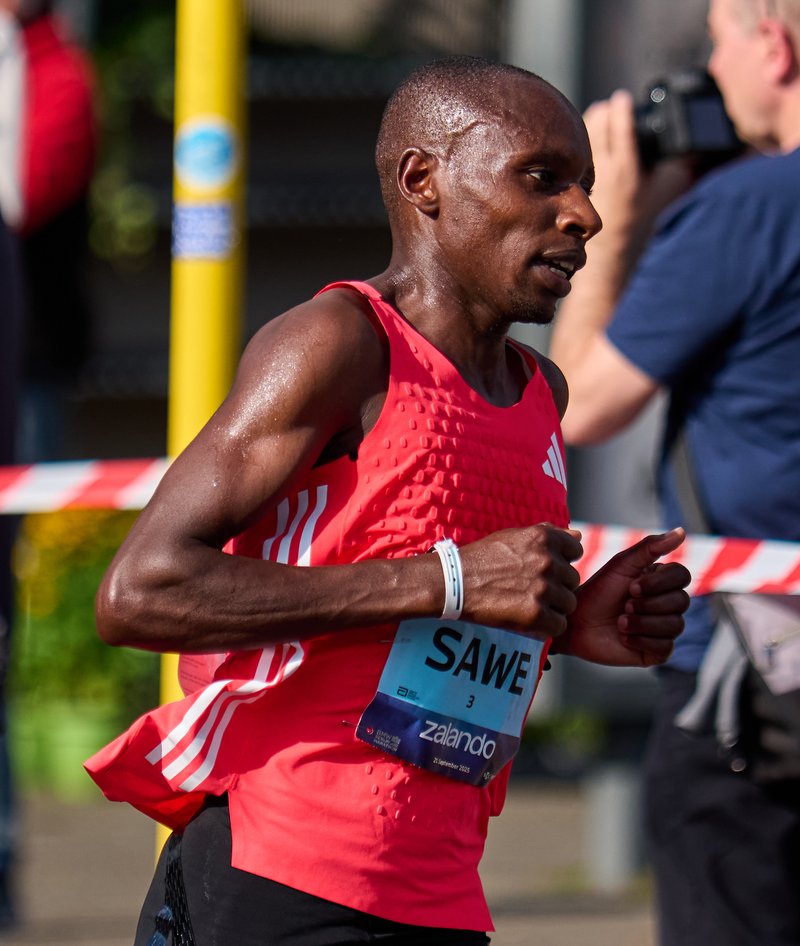 Sabastian Sawe at the Berlin Marathon, 21 September 2025. Photo: Leonhard Lenz, via Wikimedia Commons (CC0).
Kenya's Sabastian Sawe won the London Marathon on Sunday 26 April in 1:59:30, becoming the first person ever to run under two hours in an official, record-eligible marathon. It took 65 seconds off the world record and answered a question the sport had been asking for more than a decade.
It is a different milestone from Eliud Kipchoge's famous 1:59:40 in Vienna in 2019. That run used rotating teams of pacers and a car setting the pace, and it was not held under competition rules, so it was never recognised as a world record. Sawe's was run in an open race against a full elite field, and it was ten seconds faster than Vienna.
How the race was won
Six men were together at 5km: Sawe, Ethiopia's Tamirat Tola, Yomif Kejelcha and Deresa Geleta, Uganda's Jacob Kiplimo and Kenya's Amos Kipruto. The pacemakers kept the wind off the leaders until after 25km, and from there Sawe started to push.
He broke contact with the chasers at around 35km and ran the last seven kilometres at an average inside 2:48 per kilometre, which is extraordinary pace that late in a marathon. His average for the whole race was 2:49.9 per kilometre, about 21.2km/h, held for almost two hours.
Two men under two hours
The most remarkable thing about the race may be what happened behind the winner. Kejelcha, making his marathon debut, finished second in 1:59:41. That made him the second man ever under two hours in a legal race, eleven seconds after the first. It was the fastest marathon debut in history and the fastest time ever run by someone who did not win.
Kiplimo was third in 2:00:28, a Ugandan record and also faster than the world record Kelvin Kiptum had set in Chicago in 2023. Three men went under the old record in the same race. Kipruto was fourth in 2:01:39.
Britain's Mahamed Mahamed was tenth in 2:06:14, and Ireland's Peter Lynch ninth in a national record of 2:06:08.
The record he broke, and the man who set it
The previous record was Kiptum's 2:00:35, run in Chicago in October 2023. It was the closest anyone had come to the barrier, and many expected Kiptum to be the man who broke it. He was killed in a car crash in February 2024, aged 24, without ever getting the chance.
Sawe dedicated the win to him directly. "He inspired many to work hard and break the record. From the hard work he put in and the discipline he had I am sure he is proud of what I have done." The following day, still taking it in, he told reporters simply: "Nothing is impossible. Everything is possible."
Who Sabastian Sawe is
Sawe was born in March 1995 in Uasin Gishu County in Kenya's Rift Valley and made his name on the roads over half marathon. He won the world road running title over the distance in Riga in 2023 and has run 58:05, one of the fastest half marathons in history.
His marathon career has been short and remarkably consistent. He ran 2:02:05 on his debut in Valencia in 2024, then won London in 2025 in 2:02:27 and Berlin that autumn in 2:02:16. He came into London 2026 as the defending champion.
Why two hours mattered
The two-hour marathon has been treated as the sport's version of the four-minute mile. It is not just a round number but a real question about what the human body can do. Paula Radcliffe, the former women's world record holder, called it "an iconic barrier" and said there had been "this discussion over for a long time about whether it is even possible."
Kipchoge's Vienna run showed it could be done in a lab setting. Sawe's showed it could be done in a race, under the rules, against people trying to beat him. That is the version that counts, and it happened on the streets of London.