Manchester Marathon 2026: Results, Course and How to Enter 2027
Yohan Lidove and Naomi Robinson won on a course its organisers call the UK's flattest. How the 2026 race unfolded, the course and its history, and what is known so far about entering 2027.
By Miles Ashworth · 20 Apr 2026 · 3 min read · Australia edition
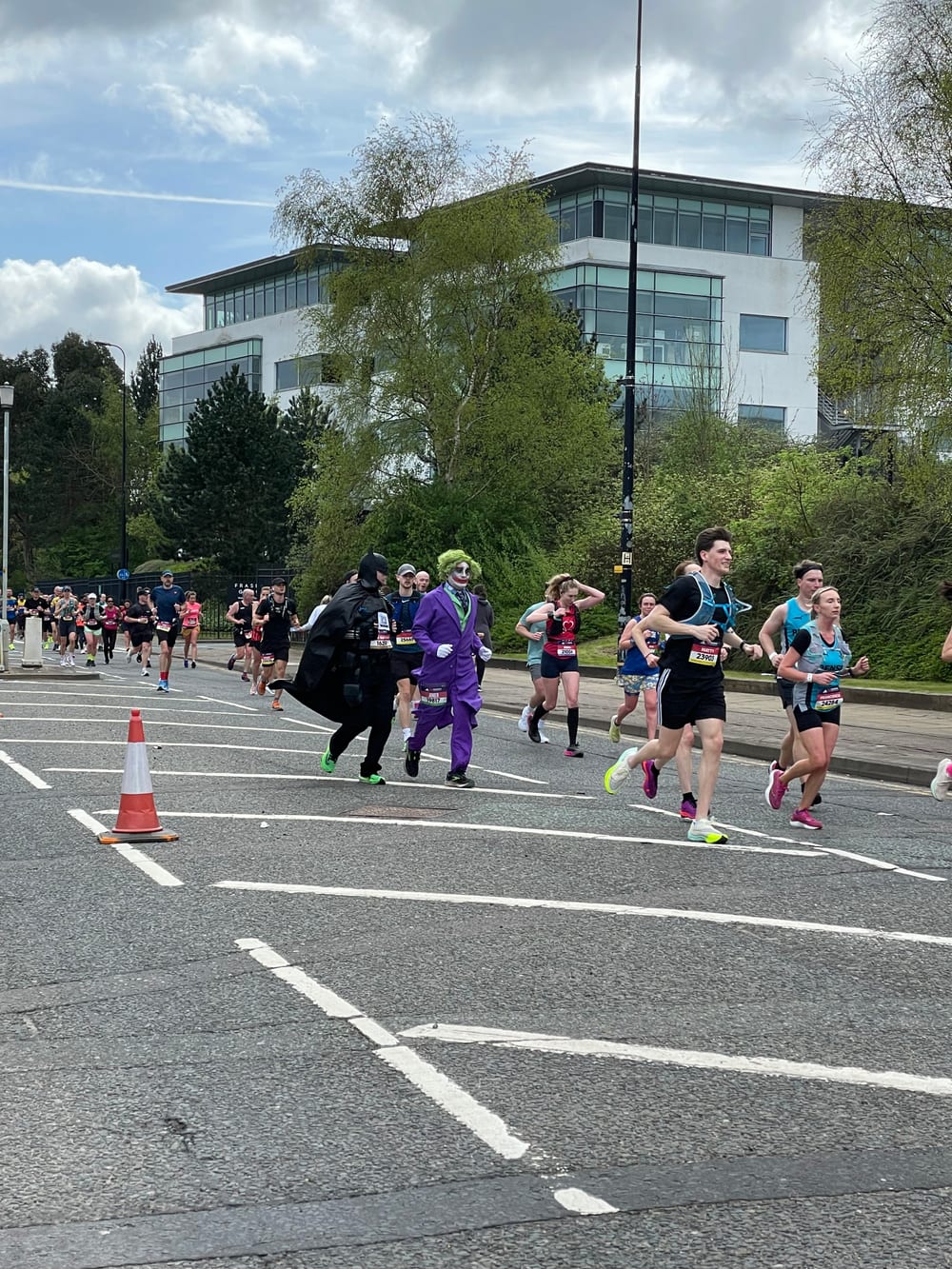 Runners, including a few in costume, along the 2026 Manchester Marathon route. Photo: Eirian Evans, via Geograph (CC BY-SA 2.0).
The Manchester Marathon returned on Sunday 19 April 2026 under bright blue skies and in near-perfect running conditions. Yohan Lidove won the men's race in a personal best of 2:15:19, and Naomi Robinson took the women's title in 2:36:56, her second Manchester win. More than 40,000 people took part, with big crowds along the route, and the race again lived up to its reputation as one of the fastest marathons in the UK.
The results
The men's race was close to the end. Lidove crossed the line 23 seconds ahead of William Strangeway, who finished second in 2:15:42, with Charlie Brisley third in 2:16:04.
The women's race was more one-sided. Robinson dominated for long spells, holding off a spirited challenge from Heather Townsend, who finished second in 2:37:40. Louise Flynn was third in 2:44:21.
The wheelchair athletes started first, and Calum Hall won the men's wheelchair race in 1:47:35, ahead of Bret Crossley in 1:55:32 and Josh Hickinbottom in 2:00:03.
The winning times were some way outside the course records, which remain Jonny Mellor's 2:10:46 from 2022 and the women's record of 2:31:27 set in 2023.
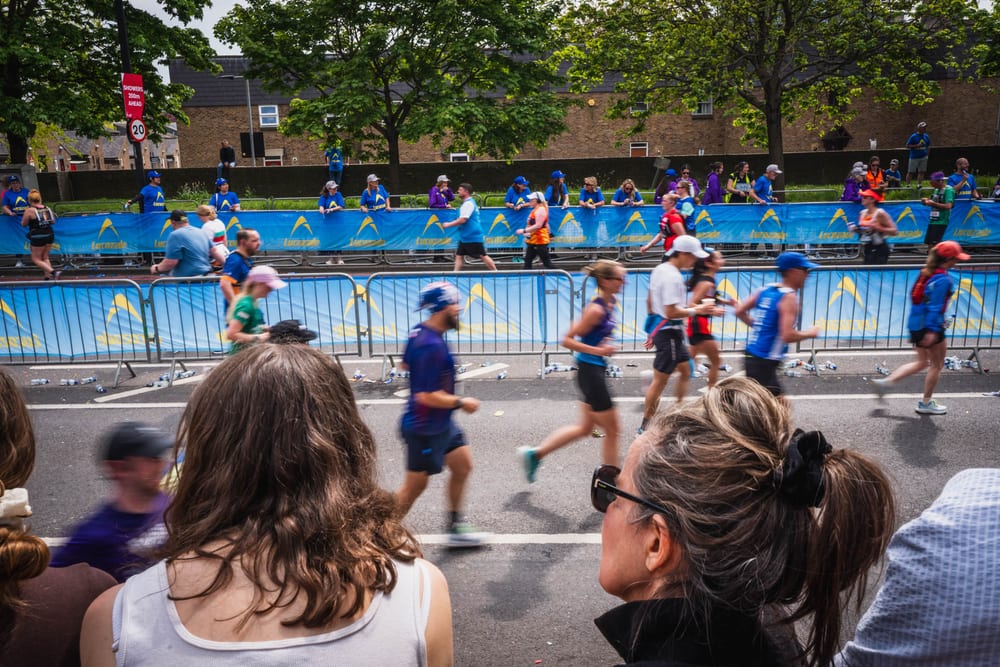
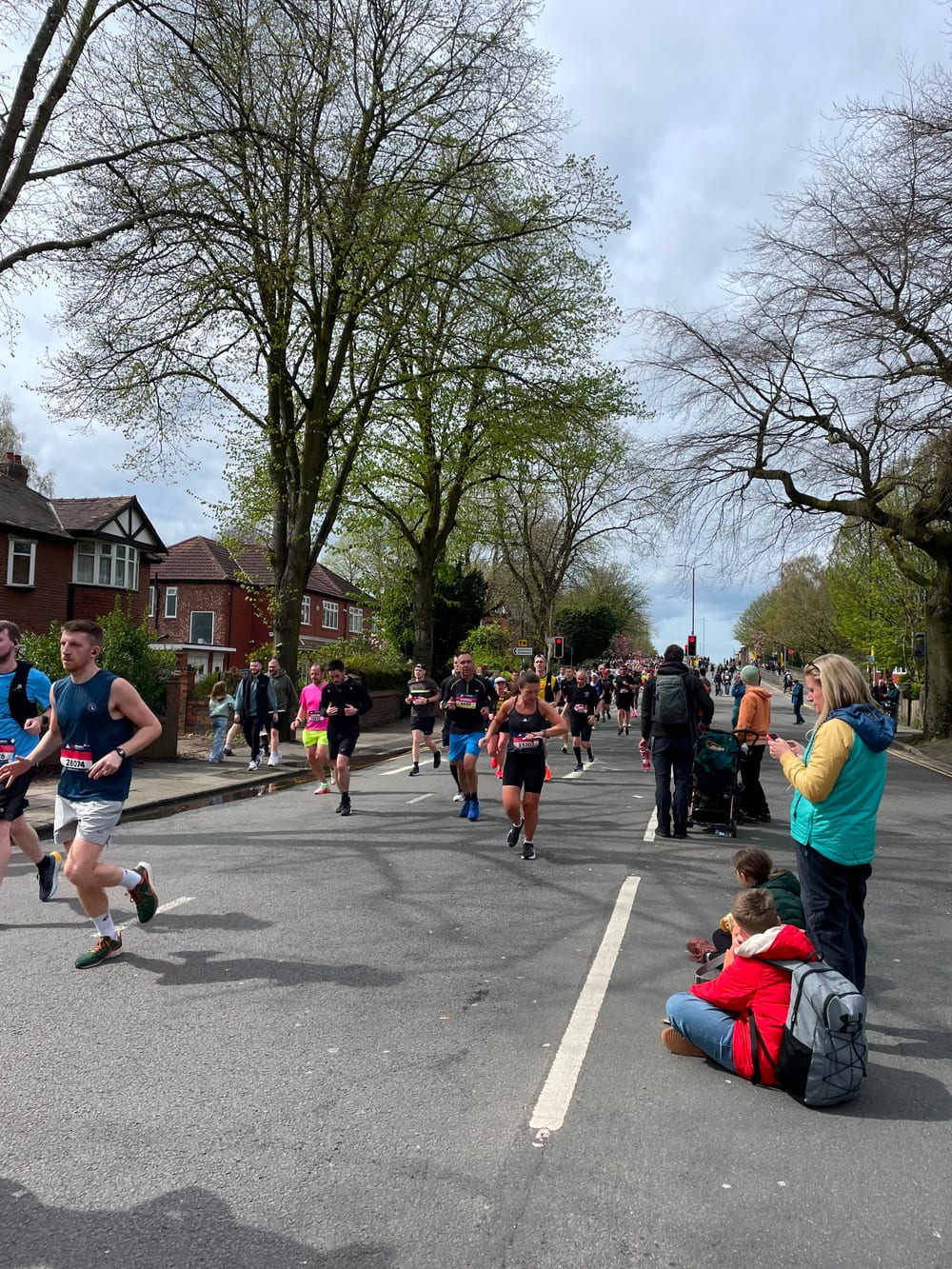 Runners and spectators along the Manchester Marathon route. Photo: Eirian Evans, via Geograph (CC BY-SA 2.0).
The course
The race starts on Trafford Way, close to Manchester United's Old Trafford stadium, and finishes on Oxford Road near All Saints Park. In between it passes through Chorlton, Hulme, Stretford, Sale, Timperley, Altrincham, Urmston and Salford before a loop of the city centre, added in 2020, takes runners to the finish.
For long stretches it is a residential course, running past terraced streets and front gardens rather than monuments. The organisers claim it is the flattest marathon course in the UK, with only 54 metres of elevation over the full distance. That is a big part of why so many runners choose it for a serious attempt at a personal best.
A course with a history
The flat-course reputation has not come without controversy. The 2013, 2014 and 2015 races were later found to have been run over a course 380 metres short, because of an error in calibrating the bicycle wheel used to measure it. UK Athletics invalidated the times from those years, a real embarrassment for an event that has built its identity around precision and pace. The course has been re-measured and verified since, and nothing about that old error affects this year's results.
The event itself has a much longer history than most people realise. A Manchester race was first held in 1908, over 20 miles, and at the full marathon distance the following year. After a ten-year gap from 2002, the modern event was revived in 2012 and has grown into one of the biggest marathons in Europe. The 2024 edition alone had more than 21,000 finishers.
Entering the 2027 edition
The 2027 Manchester Marathon is confirmed for Sunday 18 April, but entry is not open yet. The organisers currently have only a "register interest" page live, with no pricing published. Runners hoping for a place should sign up for notifications rather than wait for a general announcement. Spaces have sold out quickly in past years, precisely because of the race's flat, fast reputation.